3F Duality
Topics
- Dual Spaces and the Dual Map
- Kernel and Range of the Dual
- Matrix of the Dual
Dual Spaces and the Dual Map
Content
Definition: Linear Functional
A linear frunctional on is a linear map from to . In other words, a linear functional is an element of .
Definition: Dual Space, V'
The dual space of , denoted , is the vector space of all linear functionals on . In other words, .
Lemma:
Let be a finite-dimensional vector space with basis . The dual basis of is the list of elements in , where each sends to and all other 's to
Proof:
Let . Then because ,
Definition: Dual Basis
Let be a finite-dimensional vector space with basis . The dual basis of is the list of elements in , where each sends to and all other 's to
Lemma: Dual Basis and Linear Combination Scalars
Suppose is a basis for and is its dual basis. Then for every , .
Proof:
Let . Because is a basis for , there exist unique scalars such that . Now, apply any to this equation. Because is linear, we get
Lemma: Dual Basis is a Basis for the Dual Space
Suppose is a finite dimensional vector space and is a basis for . Then is a basis for
Proof:
We will show linear independence, which is sufficient for showing it is a basis because of the list's length. Suppose . Applying this map to any must be , and also applying this map to any results in . So every must be .
Definition: Dual Map,
Let . The dual map of is the linear map defined for each as
Lemma: Algebraic Properties of Dual Maps
Suppose . Then a) for every . b) for all . c) for all .
Proof:
The proofs of (a) and (b) are left to the reader. To prove (c), we use the definition:
Kernel and Range of a Dual
Content
- Definition: Span (of an infinite space)
- Lemma: For any subset , is the smallest subspace containing .
- Definition: Annihilator,
- Theorem: Annihilators are the same for generating sets a subspaces
- Lemma: The annihilator is a subspace
- Claim 1: Basis for the Annihilator
- Lemma: Basis for an Annihilator
- Theorem: Dimension of an Annihilator
- Corollary: Condition for the annihilator to equal or the whole space
- Claim 2:
- Claim 3:
- Setup: Objects and Figures used for the rest of the section
- Lemma: The Kernel of
- Theorem: is surjective is injective.
- Lemma: The range of
- Theorem: is injective is surjective
We start with a slight deviation from the book.
Definition: Span (for infinite sets)
Let . Then
Lemma: Smallest Subspace
For any subset , is the smallest subspace containing .
Proof:
(Sketch) a) To show that contains the zero vector, that it has closure under vector addition and also closure under scalar multiplication, we note that all three statements can be expressed as linear combinations of elements in . That latter two involve adding and scaling linear combinations. b) For the smallest subspace claim, clearly conains because for every , so we just need to show that every subspace containing U must contain everything in span(U). This follows from subspaces containing all linear combinations of their elements from closure under vector addition and scalar multiplication.
Definition: Annihilator,
Let be a subset of . The annihilator of is defined as the set of linear functionals that "annihilate" everything in , specifically:
Theorem: Annihilators are the same for generating sets of subspaces.
Let and let . Then .
Proof:
The inclusion follows from the fact that any sends everything in to , so it automatically sends everything in to as well because everything in is also in . The other inclusion follows from the linearity of the functionals. Suppose and let . Then And therefore
Lemma: The annihilator is a subspace
Let . Then is a subspace.
Proof:
We use the usual subspace test. Zero vector: The zero function sends everything to , so it is in the annihilator of every subset of . Vector Addition: Suppose and let . Then
Scalar Multiplication: Suppose and . Let . Then
We now deviate more from the book, starting with a claim about a basis for the annihilator.
Claim 1: Basis for the Annihilator
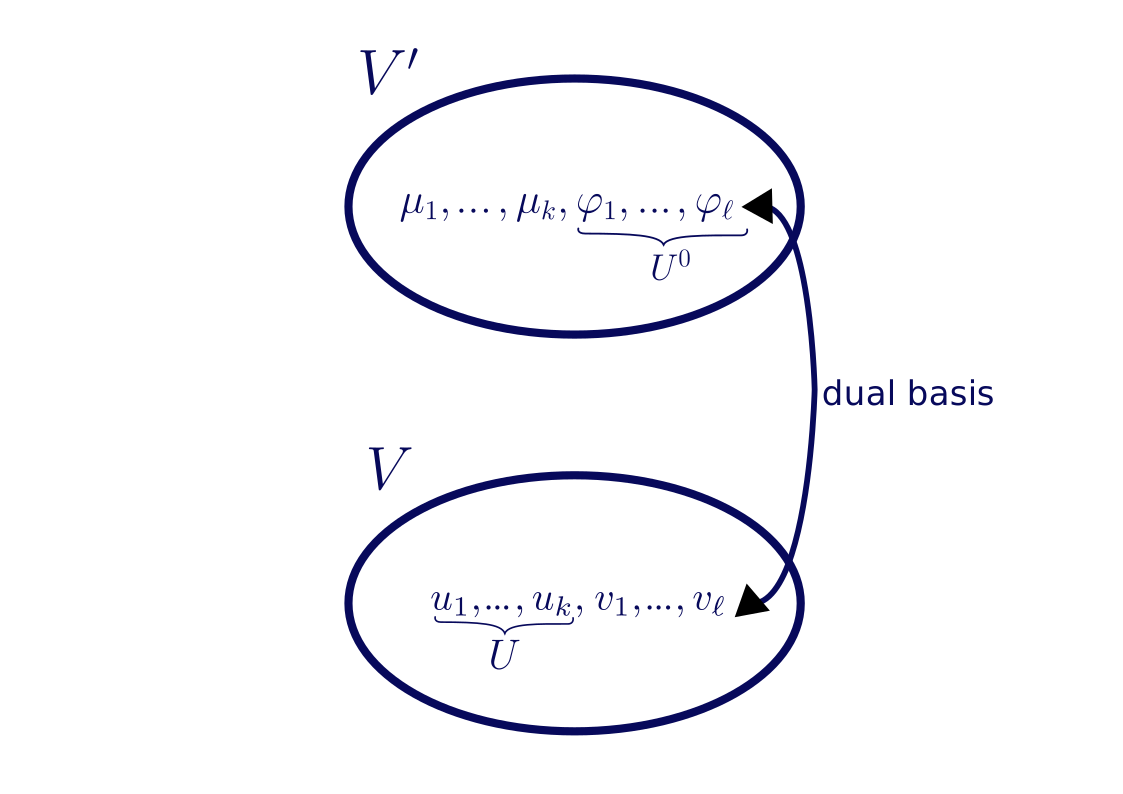
Let be a finite dimensional vector space, a subspace of , a basis for , and an basis extension for . Let be the corresponding dual basis vectors, a basis for . Then list of dual extension vectors, , is a basis for .
Proof:
This should remind you of the proof of the rank-nullity theorem. is linearly independent because it is part of a basis. Each annihilates because it sends all of the basis vectors to . Finally, is a spanning set for the following reason: For any , means that there exist scalars such that . But each must be because sends every to . So .
Theorem: Dimension of an Annihilator
Suppose is finite-dimensional and is a subspace of . Then
Proof:
In Claim 1, , , and .
Corollary: Condition for the annihilator to equal or the whole space
Suppose is a finite dimensional vector space and is a subspace of . Then a) b)
Proof:
Both conditions in part (a) happen if and only if and in Claim 1. Both conditions in part (b) happen if and only if and .
We now have two more claims related to the book's results, followed by a setup that will take care of all the remaining proofs.
Claim 2:
Let . Then .
Proof:
On the one hand, is the set of dual vectors such that for every . On the other hand, is the set of dual vectors such that for every .
Claim 3:
Proof:
Let to represent an arbitrary element . Let . Then Thus, annihilates every .
Setup for the rest of this section
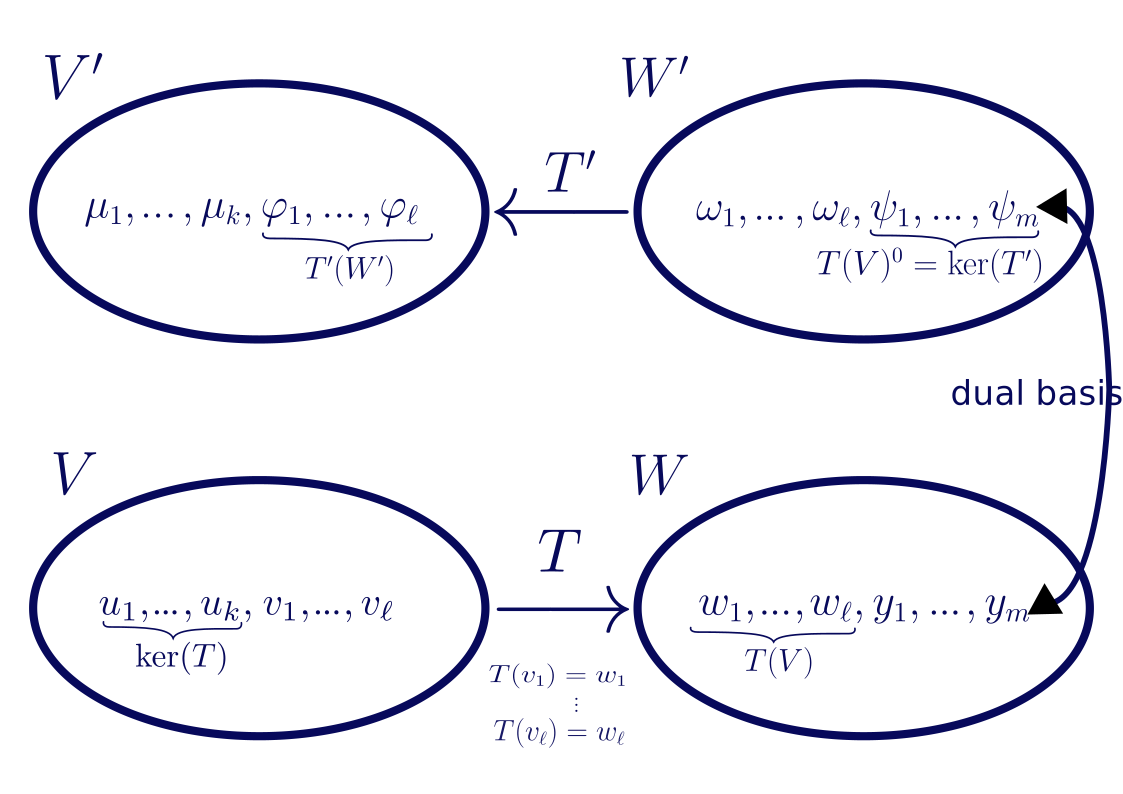
- Let , where and are finite dimensional
- Let be a basis for .
- Let be an extended basis from to . It follows from the proof of the rank-nullity theorem that is a basis for .
- Let be an extended basis for to .
- Let be the dual basis for .
- Observe that is a basis for by Claim 1 and for by Claim 2.
- Observe that the dual vectors in are a basis for by the proof the rank-nullity theorem.
Lemma: The kernel of
Suppose and are finite dimensional vector spaces and . Then a) . b) .
Proof:
a) This is Claim 2. b) LHS = , RHS =
Theorem: is surjective is injective.
Suppose and are finite-dimensional and . Then is surjective is injective.
Proof:
Both conditions happen if and only if .
Lemma: The range of
Suppose and are finite-dimensional and . Then a) . b)
Proof:
a) Both are . b) by Claim 3, and we have the other containment from having the same dimension of .
Theorem: is injective is surjective
Suppose and are finite-dimensional and Then is injective is surjective.
Proof:
Both conditions happen if and only if .
Matrix of a Dual
Theorem: Matrix of is the transpose of the matrix of
Suppose and are finite dimensional vector spaces and . Then
Proof:
(Summary) There are isomorphisms between the vector spaces and and between the vector spaces and that extend linearly from the bijection between a given basis and its corresponding dual basis. We start by observing that every column vector with respect to this basis in either or corresponds to its transpose as a functional. Now, since is pre-composition with , a dual vector in is the transpose of a vector in and of that vector is that transposed vector preceeded by . To verify this, put any dual basis vector in into the matrix and examine the corresponding column.
Theorem: Column Rank Row Rank
Suppose . Then the column rank of equals the row rank of .
Proof:
Let , , and let be the linear operator obtained by applying the matrix . Then the column rank of is the dimsion of . Recall the setup for the proofs for the previous section titled "Setup for the Rest of this Section". In that setup, is shown to be both the dimension of both and . So the row rank of , which is the column rank of , must be the same as the rank of because has the same rank as that of