"Express in Terms of"
Useful algebra, or just confusion?
Page Contents
Has this topic been confusing for you?
Many students have struggled with this topic in particular. I often thought this was because it takes some time and practice to get better at this skill. But some of your comments and questions got me wondering if part of the problem might be a lack of motivation. Why would you want to do something like this? Are we just trying to make you practice more random algebra by giving you these difficult algebra-related problems? Thankfully, no.
The Goal
The goal of this page is to help you understand the process and to give you an idea of why you would want to use this tool.
Example 1: She refused to use the quadratic formula?
I have a friend that I used to take math classes and tutor with. One day we were talking about the quadratic formula and she told me that she never, ever used it. She had always been a very strong Math student, finishing the SBCC calculus sequence when she was 14 or 15. I asked her how she solved the quadratic formula problems and she told me that she just completed the square every time. I was surprised by this, and she asked me, "Didn't you know that the quadratic formula comes from completing the square?" I did not know that. I thought it was just a formula we were randomly told to memorize. The next time our Math Lab shift was slow, I set up the generic equation
Then I slowly tried to solve for in terms of the other unknown numbers -- unknown numbers that represented the coefficients of the quadratic polynomial. It started with
and then I completed the square and continued. Each step looked like I was just completing the square for a regular polynomial, except instead of computing things with the specific numbers, I had to carefully keep track of how these unknowns were changing. I got something like
which has the square form
and finally, after a LOT of chalk and blackboard space,
And there it was, the quadratic formula. You apply the steps of completing the square, slowly and carefully without limiting , , or to specific numbers, and you get an answer for every single possible quadratic polynomial.
Expressing in terms of only one variable
Okay, so you can express one unknown in terms of the others by just solving the equation for that unknown. But these problems seem
different. And you're right to think that. The "express in terms of" problems often don't just let you express one unknown in terms
of several other unknowns. Instead, they ask you to express one unknown in terms of just one unkown. This begs two questions:
1) How in the world do you do that?
2) Why would we do something like this?
The answer to the first question is that we need extra information that connects the unknowns to each other. Then we use it to write all the extra unknowns in terms of just the unknown we want to use.
For example, if we are only considering quadratic functions where and were negatives of each other and is twice as much as , then we would know that
for all of the quadratics we are considering. So every quadratic in question can be expressed in terms of just as:
So if we wanted to express in terms of only, we could write
We could simplify, but the big win here is that we know what is in terms of just , not either of the other unknowns. The information connecting with and was what allowed us to do that.
The answer to the second question is that it is much simpler and easier to work with only one unknown.
Take a look at the next example to see how this is benificial.
Example 2: Finding the best fencing setup
Imagine you are a farmer and you want to build a pen for your animals. You know that you can use the side of your barn as one of the sides, so you will only need fencing for 3 sides. You can make the length and width pretty much whatever you want (you have a big barn, so you won't run out of space for the 4th side).
Problem 1: Express the area of the pen in terms of the length and width .
Answer: Okay, this part is probably really easy. Area for a rectangle is length times width, so it's just
Now, if this is all the information we have, this is all we can do! By having to consider all possible arrangements, we can't really norrow down any fencing relationships to force a relationship between and . But what if we did have a constraint on the fencing arrangements that forced a relationship between and ?
Problem 2: Suppose you have exactly 600 feet of fencing. If (the width) represents how far the pen goes out away from the barn, can you express the area of the pen in terms of just ?
Answer: Now that you are only considering fencing setups that match the amount of fencing you have, the fencing arrangements you would consider all force a relationship between and namely:
This means that once we make a decision about what would be, is forced to be a certain number. And we can find this number (in terms of ) by solving for :
And there we go! Once we know what has to be, we can find the area in terms of just :
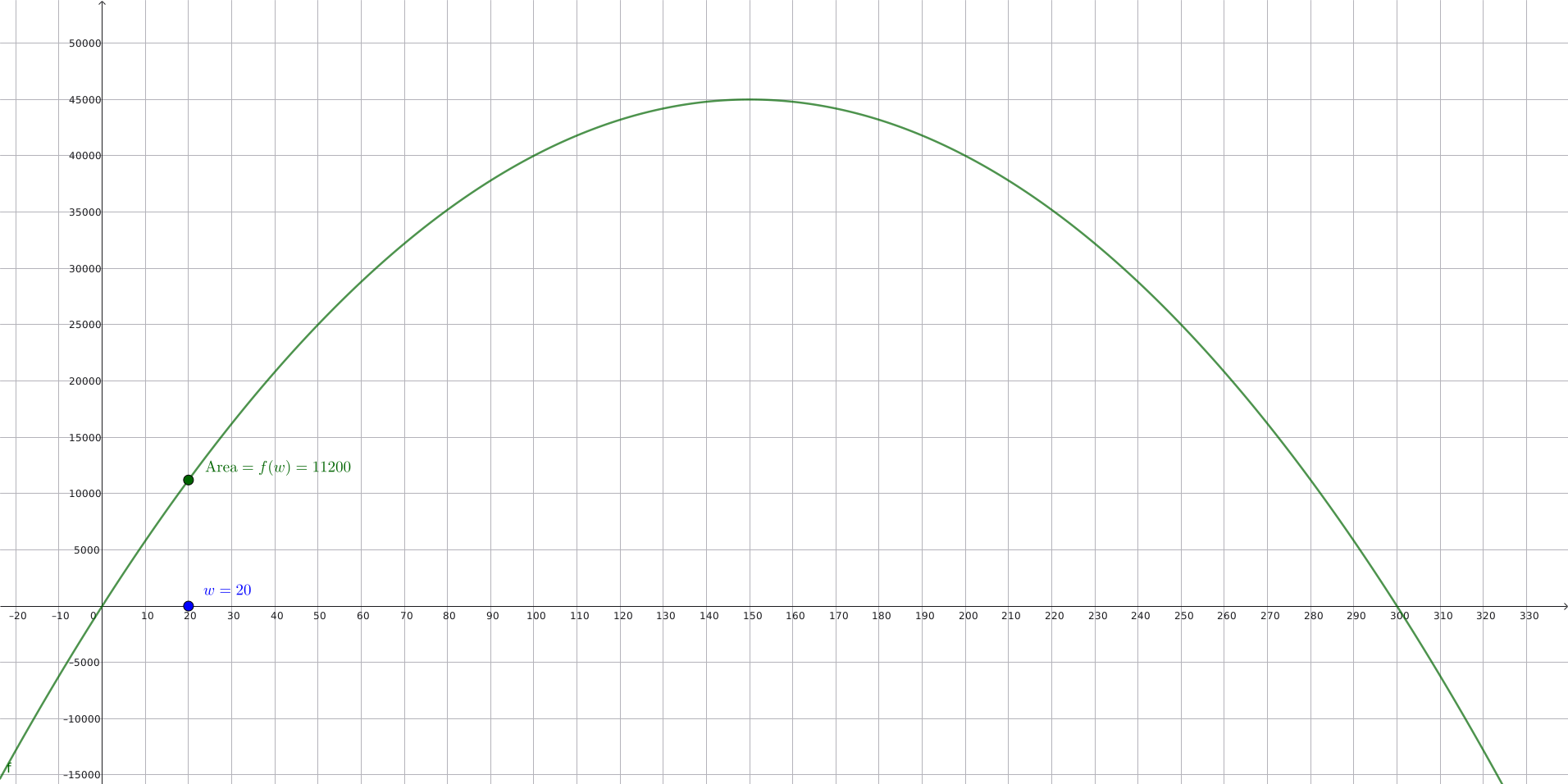
Problem 3: What is the most amount of area you could have for your pen?
Answer: At the end of the quarter, we'll learn a fancy calculus way of determining the answer to this question. In the meantime, if you haven't already, click the "Try it" button above and slide along the -axis until you line it up with the highest point on the graph. What number did you see? The number you see should be the maximum number of square feet you could have for your pen.
That's it!
Do you have a better understanding of how this works and why it is useful?